Thursday, November 28, 2019

Horrible Histories: Unaccountable Akkadians


by


Damien F. Mackey


““Uncertainty in identifying exclusively Akkadian pottery has made it impossible to reconstruct Akkadian settlement patterns with any confidence” (Nissen 1993: 100)”.


Dr. John Osgood


Dr. Donovan Courville would come to the conclusion, in his praiseworthy effort to bring Egypt and Mesopotamia into line historically and archaeologically with the biblical data (The Exodus Problem and its Ramifications, 1971), that the distinctive Jemdet Nasr (near Kish) period was archaeological evidence for the Dispersion after Babel.


Courville was quite confident that the Dispersion from Babel took place in the archaeological period known as “Jemdet Nasr.” …. The strata of Jemdet Nasr in Mesopotamia correlate to Early Bronze 1 strata in the Holy Land. It is believed that this period shows that an “intensive migration” took place from Mesopotamia into Syria, Palestine, Egypt, Asia Minor and into the Aegean islands.


Reference is made to W. F. Albright who had spoken of this period as a “transitional period” corresponding to Megiddo 19 and the lowest level of Byblos. …. It is further noted that this was a “narrow period” in Mesopotamian history, and that Jemdet Nasr had a “brief existence” and was “short.” …. The Jemdet Nasr period represents the beginnings of dynastic history, and thus represents a trend toward nationalism.

[End of quotes]


Following Dr. Osgood, I shall be suggesting a different context for the Jemdet Nasr phase, somewhat later than Babel.


My own view is that the Akkadian dynasty is represented by the sophisticated Halaf culture, currently dated to approximately (a massive) four millennia before King Sargon of Akkad (c. 2334 -2284 BC, conventional dating).

This Sargon I, ‘the Great’, may even be Nimrod himself. See e.g. my article:


Nimrod a “mighty man”


As we are now going to find, the conventional picture regarding the archaeology for the famous Akkadian and Ur III dynasties is hopelessly inadequate. Here is what I have written on this:


“Uncertainty in identifying exclusively Akkadian pottery has made it impossible to reconstruct Akkadian settlement patterns with any confidence” (Nissen 1993: 100).

Most interesting, now, that Anne Habermehl’s geographical re-location of the Babel incident:

… finds a most significant and sophisticated ancient culture to accompany it: namely, Halaf.

…. The long Akkadian empire phase of history … so admired by subsequent rulers and generations, is remarkably lacking in archaeological data. I noted this [before] ….


“The Akkadian kings were extensive builders, so why, then, so few traces of their work?


Not to mention, where is their capital city of Akkad?


The Ur III founder, Ur-Nammu, built a wall at Ur. Not a trace remains”.


…. here I want to highlight the enormity of the problem.

Archaeologists have actually failed to identify a specific pottery for the Akkadian era!

This is, of course, quite understandable given that they (indeed, we) have been expecting to discover the heart of the Akkadian kingdom in Sumer, or Lower Mesopotamia.

We read of this incredible situation of a missing culture in the following account by Dr. R. Matthews, from his book, The Archaeology of Mesopotamia: Theories and Approaches (https://books.google.com.au/books?id=9ZrjLyrPipsC&pg=PA152&lpg=PA152&dq=uncer):


The problems of fitting material cultural assemblages, especially pottery, into historical sequences are epitomised in the ongoing debate over what, if anything, characterises Akkadian material culture in Lower Mesopotamia (Gibson and McMahon 1995; Nissen 1993; J. G. Westenholz 1998).

Uncertainty in identifying exclusively Akkadian pottery has made it impossible to reconstruct Akkadian settlement patterns with any confidence (Nissen 1993: 100). The bleakest view has been put thus: ‘If we didn’t know from the texts that the Akkad empire really existed, we would not be able to postulate it from the changes in settlement patterns, nor … from the evolution of material culture’ (Liverani 1993: 7-8). The inference is either that we are failing to isolate and identify the specifics of Akkadian material culture, or that a political entity apparently so large and sophisticated as the Akkadian empire can rise and pass without making a notable impact on settlement patterns or any aspect of material culture”.


Obviously, that “a political entity apparently so large and sophisticated as the Akkadian empire can rise and pass without making a notable impact on … any aspect of material culture” is quite absurd. The truth of the matter is that a whole imperial culture has been almost totally lost because - just as in the case of so much Egyptian culture, and in its relation to the Bible - historians and archaeologists are forever looking in the wrong geographical place at the wrong chronological time.


It is my view that, regarding the Akkadian empire (and following Habermehl), one needs to look substantially towards Syria and the Mosul region, rather than to “Lower Mesopotamia”. And that one needs to fuse the Halaf culture with the Akkadian one. The most important contribution by Anne Habermehl has opened up a completely new vista for the central Akkadian empire, and for the biblical events associated with it. The potentate Nimrod, one might now expect, had begun his empire building, not in Sumer, but in the Sinjar region, and had then moved on to northern Assyria. Thus Genesis 10:10-11: “The beginning of [Nimrod’s] kingdom was Babel and Erech and Accad and Calneh, in the land of Shinar. From that land he went forth into Assyria, where he built Nineveh, Rehoboth-Ir, Calah and Resen, which is between Nineveh and Calah—which is the great city”.


And these are precisely the regions where we find that the spectacular Halaf culture arose and chiefly developed: NE Syria and the Mosul region of Assyria.


Understandably once again, in a conventional context, with the Halaf cultural phase dated to c. 6100-5100 BC, there can be no question of meeting these dates with the Akkadian empire of the late C3rd millennium BC. That is where Dr. Osgood’s “A Better Model for the Stone Age” (http://creation.com/a-better-model-for-the-stone-age) becomes so vital, with its revising of Halaf down to the Late Chalcolithic period in Palestine, to the time of Abram (Abraham):


…. In 1982, under the title 'A Four-Stage Sequence for the Levantine Neolithic', Andrew M.T. Moore presented evidence to show that the fourth stage of the Syrian Neolithic was in fact usurped by the Halaf Chalcolithic culture of Northern Mesopotamia, and that this particular Chalcolithic culture was contemporary with the Neolithic IV of Palestine and Lebanon.5:25 ....


….


This was very significant, especially as the phase of Halaf culture so embodied was a late phase of the Halaf Chalcolithic culture of Mesopotamia, implying some degree of contemporaneity of the earlier part of Chalcolithic Mesopotamia with the early part of the Neolithic of Palestine, Lebanon and Syria ….

This finding was not a theory but a fact, slowly and very cautiously realized, but devastating in its effect upon the presently held developmental history of the ancient world. This being the case, and bearing in mind the impossibility of absolute dating by any scientific means despite the claims to the contrary, the door is opened very wide for the possible acceptance of the complete contemporaneity of the whole of the Chalcolithic of Mesopotamia with the whole of the Neolithic and Chalcolithic of Palestine. (The last period of the Chalcolithic of Palestine is seen to be contemporary with the last Chalcolithic period of Mesopotamia.)


Dr. Osgood himself, however, regards the Halaf people as the biblical “Aramites” [Aramaeans]. (“A Better Model for the Stone Age Part Two”: http://creation.com/a-better-model-for-the-stone-age-part-2).


Since the Aramaeans, though, tended to be a wandering nomadic people (Deuteronomy 26:5), I would not expect their existence to be reflected in a culture as sophisticated as Halaf. Though they themselves may have absorbed some of it. My preference, therefore, is for Halaf to represent the Akkadians, especially as Halaf was the dominant culture when Osgood’s Jemdat Nasr pertaining to the Elamite Chedorlaomer, arose.


This is how Dr. Osgood sees the spread of the Halaf culture:


Now if we date Babel to approximately 2,200 B.C. (as reasoned by implication from Noah's Flood 3) and if Abraham came from Mesopotamia (the region of Aram) approximately 1875 B.C., then we would expect that there is archaeological evidence that a people who can fit the description generally of the Aramites should be found well established in this area .... What in fact do we find? Taking the former supposition of the Jemdat Nasr culture being identified with the biblical story of Genesis 14 and the Elamite Chedarloamer,4 we would expect to find some evidence in Aram or northern Mesopotamia of Jemdat Nasr influence, but this would only be the latest of cultural influences in this region superseding and dominant on other cultures.


The dominant culture that had been in this area prior to the Jemdat Nasr period was a culture that is known to the archaeologist as the Halaf culture, named after Tell Halaf where it was first identified. One of the best summaries of our present knowledge of the Halafian culture is found in the publication, 'The Hilly Flanks'5. It seems clear from the present state of knowledge that the Halaf culture was a fairly extensive culture, but it was mostly dominant in the area that we recognise as Aram Naharaim.


It is found in the following regions. First, its main base in earliest distribution seems to have been the Mosul region. From there it later spread to the Sinjar region to the west, further westward in the Khabur head-waters, further west again to the Balikh River system, and then into the middle Euphrates valley. It also spread a little north of these areas. It influenced areas west of the Middle Euphrates valley and a few sites east of the Tigris River, but as a general statement, in its fully spread condition, the Halaf culture dominated Aram Naharaim ….


The site of Arpachiyah just west of Nineveh across the Tigris River appears to have been the longest occupied site and perhaps the original settlement of the Halaf people. This and Tepe Gawra were important early Halaf towns.


The settlement of the Halaf people at these cities continued for some considerable time, finally to be replaced by the Al Ubaid people from southern Mesopotamia. When Mallowan excavated the site of Tell Arpachiyah, he found that the top five levels belonged to the Al Ubaid period. The fifth level down had some admixture of Halaf material within it. He says:


‘The more spacious rooms of T.T.5 indicate that it is the work of Tell Halaf builders; that the two stocks did not live together in harmony is shown by the complete change of material in T.T.l-4, where all traces of the older elements had vanished. Nor did any of the burials suggest an overlap between graves of the A 'Ubaid and Tell Halaf period; on the contrary, there was evidence that in the Al 'Ubaid cemetery grave- diggers of the Al 'Ubaid period had deliberately destroyed Tell Halaf house remains.’6


He further comments the following:


‘It is more than probable that the Tell Halaf peoples abandoned the site on the arrival of the newcomers from Babylonia; and with the disappearance of the old element prosperity the site rapidly declined; for, although the newcomers were apparently strong enough to eject the older inhabitants, yet they appear to have been a poor community, already degenerate; their houses were poorly built and meanly planned, their streets no longer cobbled as in the Tell Halaf period and the general appearance of their settlement dirty and poverty stricken in comparison with the cleaner buildings of the healthier northern peoples who were their predecessors.’7


He further says:


‘The invaders had evidently made a wholesale destruction of all standing buildings converted some of them into a cemetery.’8


It is clear from the discussion of Patty Jo Watson9 that the later periods of the Halaf people were found in the other regions, particularly in a westward direction across the whole area of Aram Naharaim, namely the Sinjar region, the Khabur head-waters, the Balikh River system and the middle Euphrates”.


[End of Osgood’s article]


Dr. Osgood had estimated the Halaf culture as having spread from east (Assyria) to the west: “First, its main base in earliest distribution seems to have been the Mosul region. From there it later spread to the Sinjar region to the west, further westward in the Khabur head-waters, further west again to the Balikh River system …”. Most likely, it was the other way around, with Nimrod (= Sargon of Akkad/Halaf culture) firstly having established his kingdom in the “Sinjar region”, biblical “Shinar” (Genesis 10:10): “The first centers of his kingdom were Babylon, Uruk, Akkad and Kalneh, in Shinar. From that land he went to Assyria, where he built Nineveh, Rehoboth Ir, Calah and Resen, which is between Nineveh and Calah—which is the great city”.


Andrew Moore had, as we read before, argued for a contemporaneity of the Chacolithic phase of Halaf culture with the Neolithic IV of Palestine and Lebanon ….

Archaeologically, we are now on the eve of the city building phase (inspired by Nimrod?) that will be a feature of Syro-Palestine’s Early Bronze Age. Presumably the Canaanites were heavily involved in all of this work (Genesis 10:18): “… the Canaanite clans scattered and the borders of Canaan reached from Sidon toward Gerar as far as Gaza, and then toward Sodom, Gomorrah, Admah and Zeboyim, as far as Lasha”.


Ham himself, though, son of Noah and father of Canaan, gave his name to the land of Egypt (e.g., Psalm 78:51): “He struck down all the firstborn of Egypt, the firstfruits of manhood in the tents of Ham” (http://www.topix.com/forum/afam/T2OTBS4EEA84MJ67P/p2):


“According to the Bible the ancient Egyptians were descended from Ham through the line of Mizraim. Ham had four sons: Cush, Mizraim, Phut, and Canaan (Genesis 10:6). The name "Mizraim" is the original name given for Egypt in the Hebrew Old Testament. Many Bibles will have a footnote next to the name "Mizraim" explaining that it means "Egypt." The name "Egypt" itself actually comes to us from the Greeks who gave the Land that name (i.e. "Aegyptos" from the Greek). In addition to the name "Mizraim," the ancient Egyptians also referred to their land as "Kemet" which means "Land of the Blacks." Western historians, however, say that the word "Kemet" refers to the color of the soil of the land rather than its people. But, the word "Kemet" is actually an ethnic term being a derivative of the word "Khem" (Cham or Ham) which means "burnt" or "black." Ham, who was one of the three sons of Noah and the direct ancestor of the Egyptians, was black”.


Similarly, Ham’s son, Cush (Genesis 10:6), is considered to be the father of the Cushite Ethiopians, who were (are) black.


Ham’s brother, Japheth, became the god-Father of the Indo-European peoples such as the Greeks, who would identify him as Iapetos, the Titan, and the Indians, who called him Prajapti, “Father Japheth”.


Regarding Shem, I follow the Jewish tradition that Shem was the great Melchizedek - which view is chronologically acceptable. Genesis 10:10-11: “Two years after the flood, when Shem was 100 years old, he became the father of Arphaxad. And after he became the father of Arphaxad, Shem lived 500 years [long enough to have been able to meet Abram] and had other sons and daughters”.


Tuesday, November 5, 2019

Père M-J. Lagrange’s exegetical blancmange


Lagrange portrait manteau.jpg

 
by
 
Damien F. Mackey


“To take the Genesis account as historical information … its value is
simply nil in informing us about what happened “in the night of times”.”
 
M. Lagrange


Dr. Dominque Tassot, writing an article, “The Influence of Geology on Catholic Exegesis”, for the Kolbe Center for the Study of Creation, tells us something about the opinions of M. Lagrange:
 
…. On June 30, 1909, the Pontifical Biblical Commission granted liberty to Catholic exegetes to consider the word “yom” either in its proper meaning or in a broader meaning (sensu improprio) of indeterminate duration (DS 2128). In 1896, Fr Lagrange (who had founded Jerusalem’s Biblical College in 1893) rejected “concordism,” considering that the hexameron days and geological periods did not correspond.
The shaping of the Earth went on a long time after the appearance of life; plants and animals developed in parallel. But remains established the fact that the Earth took a considerable time to form. We renounced forever the historic precise duration of six 24 hours days.7
 
My comment: The ‘Six Days’ of Genesis One, real 24-hour days, have nothing whatsoever to do with the duration of God’s work of creation, and it is futile to attempt to make them fit so-called scientific views about origins, such as the ‘Big Bang’, or an evolutionary-based geology: 
 
What exactly is Creation Science? Part One: Our Western obsession with 'Science'
 
 
Some have observed that the ‘Six Days’ (Hexaëmeron) may be a revelation of a creation already effected. Dr. Tassot continues:
 
The further influence of Lagrange on Catholic exegesis is indisputable: he devised the three main ways to render the presence of scientific errors in the Bible acceptable. These were set out in five lectures given at the Catholic Institute of Toulouse a century ago, in November 1902, later published under the title The Historical Method. I will not dispute Lagrange’s dedication to the Church and the Bible. But we will touch here upon the direct influence of geology on the exegesis of the 20th century through Lagrange’s ideas.
When a schoolboy, Lagrange used to wander with his uncle, a geologist, in the foothills of the Alps, where he lived. Maybe this explains how readily and completely he accepted the long ages, not only for the earth but also for the history of Man. He wrote in the Biblical Review, which he founded:
 
Mankind is older than one believed when piously collecting the wrecks of remembrances assumed to be primitive. (…) Humanly speaking, oral transmission from the beginning of the world is supremely unbelievable. (…) To take the Genesis account as historical information, … its value is simply nil in informing us about what happened “in the night of times.”
 
So Lagrange invented a new and paradoxical concept: “Legendary primitive history.” The Fall, the Curse, the Flood are neither true history nor simple myth. Genesis gives an account based on a “generating fact” but inevitably distorted and downgraded by the transmission through thousands of generations. Another such concept is that of “historical appearances.” Here Lagrange tried to transpose to history what Leo XIIIth said in Providentissimus Deus about astronomy (the Galileo affair!), that the Bible speaks “according to appearances.”
From a Thomistic perspective, our senses give a true path to knowledge. But in the Kantian perspective of that time, “appearance” meant the opposite of reality. In 1919, Lagrange abandoned his theory of “historical appearances,” but the idea remained that the Bible had to be confined to the sphere of religion, and this was indeed the most secure way to prevent any conflict with science.
The third method proposed by Lagrange to explain supposed natural science errors in the Bible was the theory of “literary genres.” The idea underlying this explanation was that one does not deceive when simply asserting the false, but only when teaching it:
 
All that the sacred writers teach, God also teaches and this is true. But what do the sacred writers really teach? What they affirm categorically. But—it has been said for a long time—the Bible is not a collection of categorical theses or affirmations. There are such literary genres where nothing is taught concerning the reality of the facts. They only serve as basis for a moral teaching.”8 [And further:] “It is impossible that God teaches errors. Of course [there are places in] the Bible, where everybody is speaking errors; but it is impossible that an intelligent examination of the Bible compels us to conclude that God taught errors.”9
 
It is obvious that an intelligent use of these three methods is sufficient to get rid of any difficult passage of the Bible. But the authority of the Sacred Writings disappears at the same time, divine inspiration and inerrancy being inseparable!
[End of quotes]
 
We could term this method of exegesis as emptying the Bible of all of its meaning.
 
Père Marie-Joseph Lagrange (1855-1938) was a Dominican (OP) priest and the Dominicans figure rather prominently in my life inasmuch as OP priests celebrate Masses at the University of Sydney (St. John Paul II) chapel and at Notre Dame University (St. Benedict’s), at both of which places I attend several times a week.
The day that a well-informed friend of mine queried, in an e-mail, the strange biblical views that have emanated from the École Biblique which père Lagrange himself founded in Jerusalem, I happened to attend a Mass at the University of Sydney chapel celebrated by a learned Dominican priest. I thought that I must tell him about the concerned e-mail letter that I had just received, I being particularly interested to get his (Dominican) reaction.
He is a scholar, basically a theologian, who seems to flit effortlessly around Latin, Greek, Hebrew, and French for starters. It soon became clear to me, though, that the Scriptures were essentially, for him, about theology - fair enough - but that what my colleagues and I would consider to be historical accounts were written late, perhaps beginning “about 900 BC”, and that “Moses and Joshua could not personally have written about contemporary events, nor did they record dates”. He also made the typical comment that the early Scriptures would have been passed on by means of “oral tradition”. Also fair enough, but the written aspect always seems to get downplayed. Whilst some of this was starting to rub with me, especially that Moses and Joshua did not write down the biblical events of the time, I did not feel inclined to become argumentative or contrary with a man who has an easy-going, genial nature.
But, at the same time, I tried to push home some bullet points, such as:
 
  • God told Moses and Joshua to “write”.
 
  • Moses, in Egypt, was already a learned man and a scribe. [Cf. Acts 7:22]
 
“Yes”, he replied, “but he did not write in Hebrew, but in Egyptian”.
 
Some of what the priest said here is, I believe, just plain wrong, and smacks of what I find that père Lagrange had written decades earlier.
 
Deferring to the Numbers (Chronology) Men
 
Whilst I (and apparently Monty Python) find accountancy, numbers, to be utterly BORING:
 
Counsellor: (John Cleese) Ah Mr Anchovy. Do sit down.
Anchovy: (Michael Palin) Thank you. Take the weight off the feet, eh?
Counsellor: Yes, yes.
Anchovy: Lovely weather for the time of year, I must say.
Counsellor: Enough of this gay banter. And now Mr Anchovy, you asked us to advise you which job in life you were best suited for.
Anchovy: That is correct, yes.
Counsellor: Well I now have the results here of the interviews and the aptitude tests that you took last week, and from them we've built up a pretty clear picture of the sort of person that you are. And I think I can say, without fear of contradiction, that the ideal job for you is chartered accountancy.
Anchovy: But I am a chartered accountant.
Counsellor: Jolly good. Well back to the office with you then.
Anchovy: No! No! No! You don't understand. I've been a chartered accountant for the last twenty years. I want a new job. Something exciting that will let me live.
Counsellor: Well chartered accountancy is rather exciting isn't it?
Anchovy: Exciting? No it's not. It's dull. Dull. Dull. My God it's dull, it's so desperately dull and tedious and stuffy and boring and des-per-ate-ly DULL.  ….
 
numbers appear to be greatly revered in modern times. Numbers seem to have replaced ideas.
It probably has something to do with the power that measuring offers, and, even, of man’s seeking to be ‘the measure of all things’. See e.g. my article:
 
The Futile Aspiration to Make ‘Man the Measure of All Things’
 
 
Mathematics makes a wonderful servant, but it can be a very cruel taskmaster.
Chronologists are the powerful numbers men of (ancient) history.
In Egyptology, historians and archaeologists deferred to the ‘superior wisdom’ of the numbers man, Berlin School chronologist, Eduard Meyer (c. 1906), and allowed him to create a chronology of dynastic Egypt that has little bearing on reality. See e.g. my:


Was Meyer, the numbers man, dull?
“The late great Classical scholar Werner Jaeger once said that the only time the lectures of the immortal Eduard Meyer were really interesting and the only time he was ever able to fill his lecture hall at the University of Berlin was when he talked about the Mormons”.
Enough said!
Meyer’s artificial dating of the Egyptian dynasties did not fit the shorter histories of, say, the Greeks and the Hittites. So, to save the situation, a massive slice of ‘Dark Ages’ (1200-700 BC) had to be inserted into these histories in order to ‘make’ them align with Egypt.
These ‘Dark Ages’ did not occur in real history, and their insertion has caused a disruption to the proper sequence of Greek and Hittite history.
Henk Spaan tells briefly what happened and how Dr. I. Velikovsky had identified the problem: http://www.henkspaan2.nl/velikovsky/15darkages.php
 
The history of ancient Greece is usually divided into several periods. The Archaic period is the time of ancient Hellas, that ran until about 1200 BC and ended shortly after the Trojan War. During this period Mycenae was the centre. Then followed a period of decline, the Greek Middle Ages, also called Dark Ages, when the country was invaded by primitive Dorians. The Greek heyday that we call Classical Greece, when Athens was the main centre, lasted from about 700 to 323 BC. Finally there is the Hellenistic period that begins with the conquests of Alexander the Great throughout the Middle East. In the Hellenistic period, Alexandria was the centre and the period lasted until the Roman conquest of Egypt.

The part of Velikovsky's work dealing with "the dark ages of Greece" never appeared in print. Velikovsky worked on it in the last years of his life, but could not finish it. It is published in the Internet archive of his work entitled "The Dark Age of Greece".

The Mycenaean civilization is closely linked to the 18th Dynasty of Egypt. During excavations in Mycenae, many objects from the 18th Dynasty were found and vice versa in Akhet-Aten, the city that Akhnaton had built, much Mycenaean pottery was found. This means that there must have been a period of more than 500 years between Archaic Greece that existed until 1200 BC and Classical Greece that began around 700 BC. This period is called a dark age because we know little or nothing about it and little remains of this period are found. Understanding those 500 years is difficult, because 500 years of human activity, however primitive, must have left traces above the remains of Mycenaean civilization and there must have been rulers, however barbaric, about whom people wrote of with fear or surprise. However, those traces are not there and neither are the stories. Of the Greek Middle Ages we know of no people like Vikings or Charlemagne of AD history.

Yet, if we move the Mycenaean civilization to 500 years later, it will be closer in line with the rise of Classical Greece and we are then more in line with what, for example, Herodotus and other Greek historians thought about their past. Furthermore, many problems become easier. For example, the famous riddle: how could Homer write a detailed report of the Trojan War if the war took place more than 500 years before Homer wrote his work?
 
[End of quote]
 
Thus, when the likes of W.F. Albright, in close alliance with the École Biblique, attempted to date Joshua’s Jericho, the absence of any Mycenaean pottery at the site meant that - at least according to what Eduard Meyer had established chronologically about the Egypt of the same time, that it was to be dated to c. 1400 BC - the Jericho destruction would inevitably have to be shifted back centuries before this time.
A major part in all of this was played by another (pottery-) chronologist (numbers man) and another Dominican, père Louis-Hugues Vincent, who joined the École Biblique only a year after it was founded. Of course, coming for a Lagrangian background, père Vincent was always going to be operating from a base of biblical fluidity.  
He, being a pottery-chronologist, was accorded a respect similar to that of the ‘expert’, Meyer. Consequently, we now find ourselves in the situation in which the biblical events have been separated from their right archaeology and history by many centuries – almost a millennium in the case of the famous Jericho incident. 
One of my correspondent’s main concerns was that this - the Bible’s no longer fitting with the textbook history - was one of the reasons why many dismiss much of the Scriptures as being myth or fantasy, having little in the way of historical credibility. 
“Didactic fiction” is how one elderly Dominican in Sydney has described the Book of Jonah.
 
Not that the Bible is essentially about history, or science, of course.
For the Dominican priest to whom I spoke, it is really about “theology”.
According to pope Francis, in Aperuit Illis, it is about “our salvation” (# 9):
 
The Bible is not a collection of history books or a chronicle, but is aimed entirely at the integral salvation of the person. The evident historical setting of the books of the Bible should not make us overlook their primary goal, which is our salvation.
 
It is clear from this, though, that the biblical books have an “evident historical setting”, contrary to Lagrange’s view that early Genesis is pre-historical, but also non-historical (see below).
Dei Verbum even has “our first parents” (Cardinal Pell take note), Abraham, Moses, and so on.
 
3. God, who through the Word creates all things (see John 1:3) and keeps them in existence, gives men an enduring witness to Himself in created realities (see Rom. 1:19-20). Planning to make known the way of heavenly salvation, He went further and from the start manifested Himself to our first parents. Then after their fall His promise of redemption aroused in them the hope of being saved (see Gen. 3:15) and from that time on He ceaselessly kept the human race in His care, to give eternal life to those who perseveringly do good in search of salvation (see Rom. 2:6-7). Then, at the time He had appointed He called Abraham in order to make of him a great nation (see Gen. 12:2). Through the patriarchs, and after them through Moses and the prophets, He taught this people to acknowledge Himself the one living and true God, provident father and just judge, and to wait for the Savior promised by Him, and in this manner prepared the way for the Gospel down through the centuries. ….
 
M. Lagrange, on the other hand, according to the following, denied early Genesis historicity: https://exhibitions.lib.cam.ac.uk/dominicans/artifacts/the-bible-in-context/
 
His major challenge, however, would be to establish for fellow Catholics the importance of the Bible’s literary and historical contexts while still proclaiming it to be the Word of God.
To promote Catholic biblical scholarship Lagrange founded first the periodical Revue biblique which was to publish articles on exegesis by teachers at the Jerusalem school and elsewhere, and second Études bibliques, a series of commentaries which began with a study of Judges published in 1903. Church censorship was a continual possibility.
 
 
Lagrange challenged in his lectures and articles the Mosaic authorship of the Pentateuch, and he denied the historicity (though not the truth) of the creation narrative in Genesis 1–11. As a result, he found himself forbidden to publish a commentary on Genesis.
[End of quote]
 
The Dominican priest to whom I spoke did not actually deny an Adam and an Eve, but said: “The first man and woman are called Adam and Eve in Genesis, but these would not have been their real names as they are Hebrew names”.
 
I also advanced this bullet point:
 
  • The JEDP sources that scholars claim to identify in the Book of Genesis are not fundamentally the sources from which Genesis was compiled. These latter are the toledôt divisions, to be read as endings of family histories, the histories of the pre-Moses patriarchs.
 
Whilst the priest was familiar with toledôt, he did not comment on my insistence that they were endings, not headings. He admitted to being uncomfortable with JEDP – “you can’t preach it”.
I also recalled to him the case of the French Catholic physician, Jean Astruc, really a pioneer of the modern documentary sources, who had intuitively discerned that the Flood account in Genesis appeared to have been composed from more than one source. The toledôt perfectly accounts for that, of course, it having been written by Noah’s three sons.
The next series, I said, was signed off only by Shem, who must by then have become separated from his brothers, Ham and Japheth. 
Furthermore, I said, scholars who deny the influence of Moses in the compilation of the Pentateuch may not have any expertise in the ancient Egyptian language, and are not able, therefore, to discern a prevailing Egyptian influence throughout much of those books - this being an indication that these books, in their original states (before later editing) were written at an early point in time when Israel had been in close contact with Egypt, and not written in a later Babylonian period as the documentists insist.
I queried that, if the early Bible were not really historically or archaeologically relevant, why was it that there is a substantial archaeology underlying e.g. the Conquest when properly dated, and not dated according to the whims of the unreliable chronologists. The Middle Bronze I (MBI) people - the priest knew of them - basically trace the same geographical pattern as do the Exodus Israelites, and they are known to have been bearing Egyptian artefacts. But conventional historians (the more biblically-minded ones) tend to identify the partially nomadic MBI as belonging to the time of Abram (Abraham). Once we fix Abram to his right stratigraphical level, however, which is Late Chalcolithic/Early Bronze I, we can identify the destruction caused by the four invading kings as narrated in Genesis 14, Amraphel of Shinar and his confederacy.
 
All of this is a real history, with a real underpinning archaeology.

Thursday, October 24, 2019

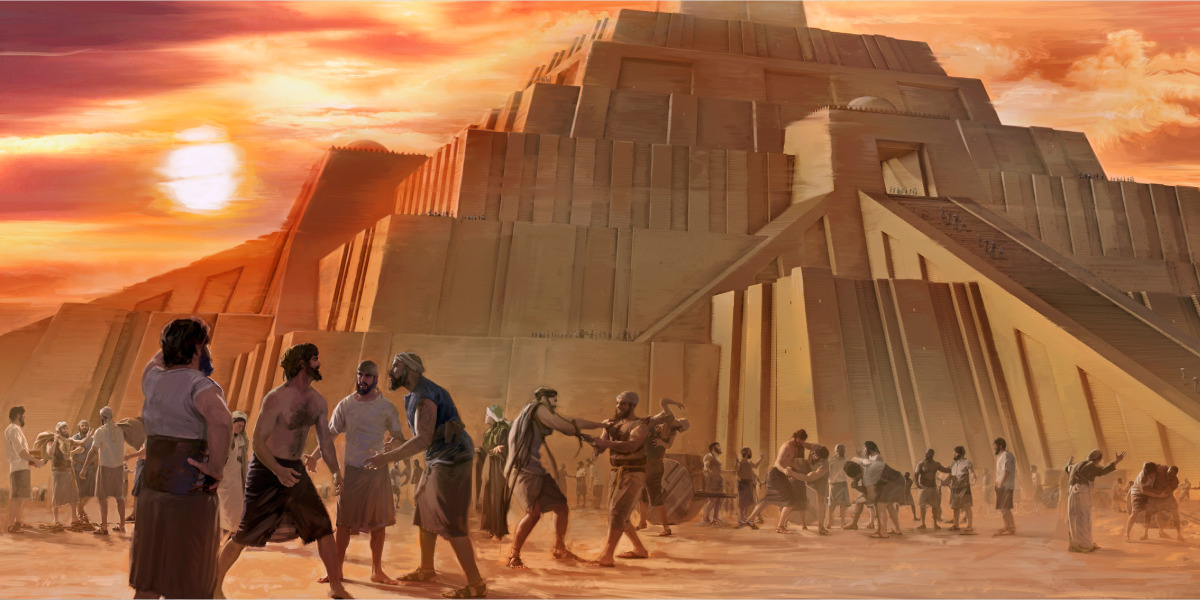
Location and Language of Babel


by


Damien F. Mackey


Now, turning to geographical considerations, “eastward” and “plain of Shinar”, there may be

a pressing need to shift the conventional goal posts. And that is exactly what Anne Habermehl has done in her ground-breaking article, “Where in the World Is the Tower of Babel?”


Language of Babel


This heading is not so much concerned about the language, or languages, spoken at ancient Babel, as about a re-consideration of the meaning of the words/phrases particularly of verse 1: “whole world”; “eastward”; “plain of Shinar”.   

Here, as in the Pentecost event of Acts 2, translations might superficially convey the impression of a global event, “whole world” (Genesis 11:1), to be compared with Acts 2:5’s “every nation under heaven”. A pairing of Babel with Pentecost is relevant insofar as the disastrous confusion of languages in the case of the former, owing to the sin of pride (Genesis 11:4, 7-9), is Divinely undone by the miraculous phenomenon of “tongues” at Pentecost (Acts 7:11): “… we hear them declaring the wonders of God in our own tongues!”    


With the benefit of such a comparison it may be suggested that the confusion of languages was, just as was the Flood, only “local in geographic extent” (for full quote, read on further).


The different and contemporaneous Sumerian and Akkadian languages may have been a result.


Matt Lynch, however, has a somewhat different take on Babel and Pentecost (2016):


Pentecost — A Reversal of Babel?


Once, when I was teaching a church class, two people started speaking to each other in German. It made things easier for them because it was their native language. But it didn’t make things easier for Margaret (name changed). With deep frustration she exclaimed, ‘Can we just speak English here!’


The experience of linguistic diversity leads many to wish for unity—or rather, homogeneity. Wouldn’t it be nice if everyone just spoke normal (i.e., English)?  That desire for intelligibility is understandable, but the desire for that language to be English can also betray ethnocentrism. Especially from where I come in the U.S., which has no national language, the fight to retain English can easily slide into a fear-driven attempt to keep ‘our’ culture and ‘our’ language dominant.


Confusion over Babel


Yesterday the church celebrated its founding linguistic event—Pentecost—an event that many hail as the definitive reversal of Babel. Whereas at Babel, God confused languages, at Pentecost, God brought people of all languages together and united them. At Babel tongues were confused. At Pentecost, tongues were understood. You get the idea.

However, Pentecost may not be anti-Babel in the way some suppose. For starters, the reversal idea assumes that a unified language was a good idea gone wrong, and that eschatological unity would somehow involve a return to one language—a Spirit language.


But Genesis never states that the confusion of languages was a bad thing. The only downside was for the Babelites, who couldn’t finish their Manhattan project. On the positive side, language diversification enabled humanity to get on with the task of ‘filling the earth,’ something they were meant to do but didn’t because of their big hero project. Notice the language in Gen 11:4:


Come, let us build ourselves a city, and a tower with its top in the heavens, and let us make a name for ourselves; otherwise we shall be scattered abroad upon the face of the whole earth.


God had wanted humans to ‘fill the earth’ (Gen 1). Babel was in direct contravention of God’s intended vision of teeming diversity.

At Pentecost, God embraces language diversity. He doesn’t destroy it. So yes, the Spirit reverses the imperial unification of Babylon, but not the multiplication of languages.


Empires and Language


To see why the preservation of multiplication is important, it’s important to grasp the imperial function of language unification. Joel Green helps us here:

The wickedness of this idolatrous plan [to build Babel] is betrayed in the opening of the Babel story, with its reference to ‘one language’—a metaphor in the ancient Near East for the subjugation and assimilation of conquered peoples by a dominant nation. Linguistic domination is a potent weapon in the imperial arsenal, as people of Luke’s world themselves would have known, living as they did in the wake of the conquest of ‘the world’ by Alexander the Great and the subsequent creation of a single, Greek-speaking linguistic community.[1]


By confusing languages God was merciful, not punitive. He already recognized that ‘this is only the beginning of what they will do’ (11:6). Who knows what WMDs the Babelites would’ve created? Middleton writes, ‘Babel thus represents a regressive human attempt to guarantee security by settling in one place and constructing a monolithic empire, with a single language, thus resisting God’s original intent for humanity.’[2]


So God gave humanity a push toward its original purpose, to fill the world, cultivate it, build cultures, and grow. Linguistic diversity is a natural outgrowth of this process, and one which the Spirit rubber stamps at Pentecost.


Israel& the Nations


But before we land on Pentecost, it’s important to look at a few snapshots of Israel’s ‘universal’ vision in Isaiah:


In days to come the mountain of the LORD’s house shall be established as the highest of the mountains, and shall be raised above the hills; all the nations shall stream to it. … For out of Zion shall go forth instruction, and the word of the LORD from Jerusalem. (Isa 2:2-3)

I am coming to gather all nations and tongues; and they shall come and shall see my glory… And I will also take some of them as priests and as Levites, says the LORD. … From new moon to new moon, and from Sabbath to Sabbath, all flesh shall come to worship before me, says the LORD. (Isa 66:18, 21, 23)


In the first vision, the nations come to receive instruction from Israel. In the second, they come to worship, and some even becomes priests. They come as nations, with all their diversity of languages (‘nations and tongues’). And, they retain their identity as nations. They neither dissolve into one gigantic Israelite world empire nor isolate themselves completely.


Israel’s worship system includes foreigners and receives the nations’ offerings, while the nations receive teaching from Israel.


Pentecost—Preservation and Unification


When we turn to Pentecost, we see that the Spirit is similarly uninterested in unifying language: ‘Jews … from every nation under heaven … each one heard them speaking in the native language of each’ (Acts 2:5-6).

Things were getting out of hand, so Peter stood up to interpret the event. He did so by drawing on Joel 2, which anticipated a work of the Spirit that obliterated a different sort of division. Here’s Peter quoting from Joel 2:28-29:


In the last days, God says, I will pour out my Spirit on all people. Your sons and daughters will prophesy, your young men will see visions, your old men will dream dreams. Even on my servants, both men and women, I will pour out my Spirit in those days, and they will prophesy. (Acts 2:17-18)


The point couldn’t be clearer—the Spirit gave without regard for status, sex, or nationality. In giving, the Spirit unified the people of God (‘tearing down the dividing wall of hostility’ Eph 2:14), but in a way that preserved their cultural diversity. One Spirit, many gifts. One Spirit, many languages. The Spirit doesn’t negate difference, but cultivates and leverages that difference in service of God’s mission toward all nations.

So yes, Pentecost reverses the homogeneity of Babel. And yes, Pentecost reverses any hostility that may have arisen in the wake of linguistic confusion. Yet, the Spirit puts the diversity of cultures (preserved in their languages) on display and empowers each for the proclamation of a de-centered Good News. This was a profoundly anti-imperial move.  The point isn’t that the Spirit speaks one language. Instead, the Spirit speaks your language—no matter who you are. ....


Returning now to the subject of geographical extent, for the Flood, for Babel, Rich Deem has written of “The Genesis Flood Why the Bible Says It Must be Local”:


“Psalm 104 directly eliminates any possibility of the flood being global (see Psalm 104-9 - Does it refer to the Original Creation or the Flood?). In order to accept a global flood, you must reject Psalm 104 and the inerrancy of the Bible. If you like to solve mysteries on your own, you might want to read the flood account first and find the biblical basis for a local flood.


The Bible's other creation passages eliminate the possibility of a global flood


The concept of a global Genesis flood can be easily eliminated from a plain reading of Psalm 104,1 which is known as the "creation psalm." …. The verse that eliminates a global flood follows: "You set a boundary they [the waters] cannot cross; never again will they cover the earth." (Psalm 104:9)1 Obviously, if the waters never again covered the earth, then the flood must have been local. Psalm 104 is just one of several creation passages that indicate that God prevented the seas from covering the entire earth.2 An integration of all flood and creation passages clearly indicates that the Genesis flood was local in geographic extent”.


Now, turning to geographico-linguistic considerations re Babel, “eastward” and “plain of Shinar”, there may be a pressing need to shift the conventional goal posts. And that is exactly what Anne Habermehl has done in her ground-breaking article, “Where in the World Is the Tower of Babel?” (https://answersingenesis.org/tower-of-babel/where-in-the-world-is-the-tower-of-babel/), there shifting the geographical focus for the Tower of Babel incident away from southern Iraq (ancient “Sumer”), the customary “Cradle of Civilisation”, to the Khabur region of NE Syria. According to this new view, the biblical “land of Shinar” to whose “plain” men migrated after the Flood (Genesis 11:2), and thought to indicate “Sumer”, is roughly to be identified, instead, as the region of Sinjar (the scene of much fighting in our era).

This is how Anne Habermehl has introduced (summarised) her article:


Abstract


The biblical story of the Tower of Babel is believed by many to be the record of a real historical event that took place after the worldwide Flood, at a time when the earth’s population still lived together in one place. The enduring archaeological question, therefore, is where the Tower of Babel was built. It is widely considered that Shinar, where the Bible says the Babel event took place, was a territory in south Mesopotamia; and that Babel was located at Babylon. However, an analysis of history, geography, and geology, shows that Shinar cannot have been in the south, but rather was a territory in what is northeastern Syria today; and that the remnants of the Tower must be located in the Upper Khabur River triangle, not far from Tell Brak, which is the missing city of Akkad.


An immediate point in Habermehl’s favour is that she has been able to, in her scholarly and well-researched article, provide a fairly compelling identification (namely, Tell Brak) for the lost city of Akkad (Accad), Nimrod’s city (Genesis 10:10), so famous in ancient times, but not identified even to this day.


Akkad is generally estimated to have been situated in the environs of modern Baghdad.


As to the word, “eastward”, one may have to ask, “eastward” from where?

Various translations of the word, the Hebrew miqqedem (מִקֶּדֶם), are “from the east”, “in the east”. The Ark survivors were last heard of “on the mountains of Ararat [Urartu]”, which is already close to the eastern extremities of the ancient world. It is unlikely that preserved humanity travelled even further “eastwards” (or its variants) than this in search of fertile habitable land.

Hebrew miqqedem also has the meaning “of old [long ago”], which makes more sense to me.

Further, regarding the location of the Tower of Babel, the Septuagint (LXX) Isaiah provides a geographical clue which, whilst conforming with Habermehl’s location of biblical “Shinar”, would not, however, support a conventional location of the land as Sumer, nor anywhere further “eastward”. In Ellicott's Commentary for English Readers we read this intriguing information, regarding Isaiah 10:9: “Is not Calno [Calneh] as Carchemish? is not Hamath as Arpad? is not Samaria as Damascus?” (“... instead of naming Carchemish, gives “Calanè, where the tower [ὁ πύργος] was built ...”):
 
“…. Is not Calno as Carchemish?—The six names obviously pointed to more recent conquests in which Sargon and his predecessors had exulted. One after another they had fallen. Could Judah hope to escape? (1) Calno, the Calneh of Genesis 10:10, Amos 6:2. That prophet had held up its fate in vain as a warning to Samaria. …. The LXX. version, which instead of naming Carchemish, gives “Calanè, where the tower [ὁ πύργος] was built,” seems to imply a tradition identifying that city with the Tower of Babel of Genesis 11:4. (2) Carchemish. Few cities of the ancient world occupied a more prominent position than this. Its name has been explained as meaning the Tower of Chemosh, and so bears witness to the widespread cultus of the deity whom we meet with in Biblical history as the “abomination of the Moabites” (1 Kings 11:7)”.
 
Some have even associated the god Chemosh with Ham himself, the son of Noah.


This switches the land of the Tower of Babel away from Sumer to the vicinity of Carchemish.

The name, Carchemish, including apparently the meaning of “Tower”, may indicate that this is where the attempted building of the Tower of Babel had been undertaken.

It could not have been in the well-known Babylon of Sumer, which city was begun much later.

Any map of Mesopotamia will show that - whether one believes Noah’s Ark to have landed on Mt. Çudi (Judi) in Kurdistan, or Mt. Ararat in Turkey - ancient Babylon is hundreds of kilometers directly south of both of these places. Various authors have pointed this out. “This somewhat inconvenient geographical fact (for those who believe that the people migrated eastward or westward) is downplayed by those who believe that the Tower was built at the city of Babylon, and requires inventing scenarios that move the people far enough south while still satisfying their perception of this Scripture”. (Anne Habermehl’s article)


Sadly, the location of other cities connected with Nimrod in this same Genesis verse (10:10): “The beginning of [Nimrod’s] kingdom was Babel and Erech and Accad and Calneh, in the land of Shinar”, is also a matter of dispute. Some translations even get rid of “Calneh” altogether, by substituting “all of these [i.e., Babel, Erech and Accad] in the land of Shinar”.

Another point in Habermehl’s favour, I think, is that her choice of Sinjar (Shinjar) for “Shinar” is far more linguistically plausible than is “Sumer”.


Scholars and historians have been totally confounded by the abrupt rise of the Sumerian culture nearly 6,000 years ago in the Fertile Crescent of the Tigris and Euphrates Rivers. This “sudden civilisation” seemed to appear out of thin air and refused to conform to the popular historical theory of linear development in cultural evolution.

Historian Professor Charles Hapgood squarely faces the issue when he writes that “today we find primitive cultures co-existing with advanced modern society on all continents… We shall now assume that 20,000 years ago while paleolithic peoples held out in Europe, more advanced cultures existed elsewhere on earth.”


Likewise the rise of Sumeria has been a major puzzle.


Joseph Campbell in The Masks of God writes, “With stunning abruptness… there appears in this little Sumerian mud garden… the whole cultural syndrome that has since constituted the germinal unit of all high civilisations of the world.”

William Irwin Thompson puts it even more succinctly. “Sumer is a poor stoneless place for a neolithic culture to evolve from a peasant community into a full-blown civilisation,” he writes, “but it is a very good place to turn the plains and marshes into irrigated farmlands … In short, Sumer is an ideal place to locate a culture already having the technology necessary for urban life and irrigation agriculture.”

This would indicate that human settlement of Sumer, and the cities and culture that developed from this, had occurred somewhat later than was formerly believed.


There is to be considered the possibility that pre-Flood Cain-ites had settled there and that, after the Flood, when Sumer was re-settled, Cain-ite names were re-applied to the cities that now sprang up there. My earlier view had been, in line with others, that cities named after the Cain-ites (Enoch, Irad, Tubal-cain) were identifiable in the names of southern Mesopotamia cities. According to: http://xenohistorian.wordpress.com/2008/03/31/the-babylonian-connection-


David Rohl has proposed that both Uruk and Ur were named after Enoch, because their actual Sumerian names were Unuk and Unuki, respectively. Rohl goes on to see a connection between Bad-tibira and Tubal-Cain, because Bad-tibira means “City of the Metal Worker.” Finally, Eridu, which archaeologists and Sumerian historians believe is the oldest city of all, could have been named after Irad (according to Rohl) or Jared (according to Zecharia Sitchin).


Cain himself, though, as traditions seem to indicate, settled on the edge of “Seth’s land”. According to what we learned earlier, Cain had not moved far from the vicinity of the Garden of Eden.


As already touched upon, NE Syria is also more geographically proximate (than is Sumer) for the descendants of Noah from my point of view (Habermehl is obviously a global Floodist), according to which Noah’s Ark landed upon the mountains of modern Kurdistan (ancient Urartu). It might be expected, then, that humankind would soon find its way into the fertile Khabur region. That this region qualifies as a “plain” is apparent from Habermehl’s description of it (she includes a photograph):


“It is difficult to tell from what we know of history exactly where the boundaries of the entire land of Shinar were; indeed, those boundaries may not even have remained precisely the same at different times. However, we will generally describe Shinar as a land including the territory that is located immediately south of the Turkish mountains between the Tigris and Euphrates rivers. This area is almost perfectly flat as far as the eye can see (fig. 2). It surely qualifies as “a plain in the land of Shinar,” as Genesis calls it”.


There is yet another most useful upside to Habermehl’s reconstruction; one that she herself has pointed out, and it is not favourable to the documentary theory: “One result of “moving” Babel from south Mesopotamia to the north of Syria is that secular historians will no longer be able to claim that the building of the Tower was merely a story inspired by the ziggurat at Babylon (for example, Parrot 1955, p. 17)”.


In fact, with the early Genesis scene shifted right away from Babylonia, then those old arguments according to which the Book of Genesis (e.g., the Flood) had borrowed from Mesopotamian lore will no longer carry any force.

It is well known where the ancient city of Babylon stood. But - and as Habermehl strongly - argues, Babylon and the “Babel” of Genesis 10:10 are not necessarily synonymous.

Habermehl herself does not actually identify the location of Babel. She presumes that it must lie at the approximate centre of the triangle of cities that she has associated with Genesis 10:10.

But might not the LXX be telling us, by substituting the name “Babylon” for “Carchemish”, that the impressive site of Carchemish (modern Jerablus) was itself a Babylon, a Babel? – perhaps in close association with Calneh – in the very region “where the Tower was built”?


One unusual French scholar, Fernand Crombette, whose unique and complicated method of translating ancient texts with the aid of Coptic has bemused many, had claimed that Carchemish was where Noah and his sons lived after the Flood, and that its modern name, Jerablus, actually translates as The Naked Man (L‘homme nu), referring to the incident of the drunken Noah (Genesis 9:20-25). Given that the region of Carchemish may have been the suitable place for grape vines: “In Mesopotamia, grapevines could be nurtured only in the north, notably in the region of Carchemish” (P. King, Life in Biblical Israel, p. 98), then Crombette may have got this right. Northern Syria might have been, for this very reason, the first place of choice for migrations after the Flood waters had begun to subside. 


That does not necessitate, however, that all human groups, post-Flood, had converged upon the fertile “plain in the land of Shinar”.


Carchemish, once excavated by the famed adventurer, T. E. Lawrence (“Lawrence of Arabia”), but now currently situated on the boundaries of a war zone, awaits a fuller archaeological effort. “Nicolò Marchetti of Bologna University, who leads the renewed investigations with a joint Italian-Turkish team beginning in 2011, says that, despite the city's historical significance, only 5 percent of the site has been excavated”.


I personally should be most interested to find whether further excavational work at the site of Jerablus (Carchemish), or its environs, might yield any evidence of the famous Tower of Babel.